segunda-feira, 31 de julho de 2017

Gestão de Marca | Advocacia

"A reputação da nossa marca não nos pertence. Está na mente dos nossos clientes. O que está ao nosso alcance é gerir os sinais que emitimos para construir ou reforçar uma boa percepção".


quinta-feira, 27 de julho de 2017

10 top legal disruptors

Carbon law partners

01 CARBON LAW PARTNERS

“We have updated the partnership model for the 21st century,” explains Carbon Law Partners co-founder Michael Burne. The organisation, which launched in 2014, is headquartered in Cardiff with offices in Bristol and London, and acts as an umbrella company for self-employed lawyers, each of whom forms their own limited company, while Carbon Law Partners provides business services, including billing and cash collection for a small percentage of their fees. Although lawyers work independently, they also collaborate with each other and form teams to pitch for and deliver multidisciplinary projects.
Ignitionlaw

02 IGNITION LAW

This outfit supports startup and scale-up businesses. “We are part of the entrepreneurial community as well as lawyers,” says founder Alex McPherson. Ignition Law uses technology to provide real-time cost transparency and remote advice at fixed fees. The London team is supported by specialists who work from entrepreneurial hubs across the world. It has a joint venture with alternative business structure gunnarcooke and an arrangement with an accountancy firm to provide an holistic value proposition for entrepreneurs.
wavelength.law

03 WAVELENGTH LAW

Combining legal advice with “legal engineering”, Wavelength Law legal engineers design software solutions to streamline legal service delivery and troubleshoot problems. Wavelength product BackLight uses search technology, machine-learning and variance analysis to display contracts in a way that enables professionals to analyse risk, spot issues and reuse important information. BackLight was used in an innovative project with eBay subsidiary StubHub, which included creating “living” negotiation playbooks.
Donotpay

04 DONOTPAY

Stanford University student Joshua Browder’s DoNotPay chatbot has challenged 160,000 parking tickets and helped more than 3,000 vulnerable people apply for emergency housing. Its latest incarnation, on the Facebook Messenger platform, is helping refugees with immigration applications in the United States and Canada, and asylum support applications in the UK. “DoNotPay is a pure public service,” says Mr Browder, who is in separate discussions with companies about developing internal tools, for example helping to deal with sexual harassment in the workplace, and is working with IBM on the first application of quantum computing to the law.
LawBot

05 LAWBOT

Launched last November by four Cambridge University law students, LawBot is a chatbot that provides free advice to victims of crime. It covers 26 criminal offences, but is not designed to replace a lawyer or take a case forward. Rather, the idea is to help people find out how the law applies to their situation, for example whether they have been the victim of a crime. Like DoNotPay, LawBot takes the user through a series of questions and, if it finds a match for an offence, it creates a draft letter. Last month, it launched Divorce Bot, but the site is now offline until June, when the plan is to relaunch as a messenger bot and expand to further areas of law, says co-founder Rebecca Agliolo.
Farewill

06 FAREWILL

This service, launched in 2015, offers digital tools to handle the legal procedures around death and has given will-writing a digital makeover. As co-founder Dan Garrett explains, Farewill focuses on usability, enabling people to create a digital will, which can also include messages to friends and family. It is about affordability. A digital will costs £50 up-front and £5 a year thereafter buys the ability to amend it. Although the average age of Farewill customers is 33, generally following significant life events, 20 per cent of business is from the over-60s. Farewill works with charities and people in palliative care.
TrademarkNow

07 TRADEMARKNOW

This is an online tool that speeds up trademark review and clearance by calculating how close trademarks are to each other. It uses artificial intelligence to cut research time by immediately identifying anomalies. TrademarkNow was one of the first lawtech startups to raise external funding. Founded in Helsinki in 2012, angel investor Balderton Capital enabled it to expand internationally with offices in London, Luxembourg, Ireland and the United States. In 2016 TrademarkNow almost tripled in size, overhauled its core product NameCheck to include additional features and launched two new products, trademark research tool ExaMatch and image trademark clearance tool LogoCheck.
Li F Lex

08 F-LEX

Formed in 2016 by former property litigator Mary Bonsor with Legal Geek founder and serial entrepreneur Jimmy Vestbirk, F-LEX provides on-demand paralegal services for law firms and legal departments, and helps students get practical experience while they learn. F-LEX is an online portal which matches law students with appropriate and available work. It has more than 350 live profiles on the portal in London and 100 in Manchester, and is about to launch in Leeds, Birmingham and Bristol. Clients include silver circle firms, general counsels of FTSE 100 companies, boutique firms and startups.
Juro

09 JURO

Founded by former lawyer Richard Mabey, Juro provides contract automation software for corporate legal departments. With artificial intelligence features that are trained by user behaviour and feedback, including contract analytics, machine-learning and negotiation heatmaps, as well as an e-signature tool, Juro offers a one-stop shop for contracts that aims to save businesses 75 per cent of time spent on contract management. It recently raised $750,000 from Point Nine Capital, the founders of Gumtree and Indeed.com, and the general counsel of Zoopla. High-profile clients include Deliveroo, Hostmaker and Unbabel.
luminance

10 LUMINANCE

An artificial intelligence platform for document analysis, backers of Luminance include Dr Mike Lynch’s Invoke Capital and magic circle law firm Slaughter and May. Luminance is a pay-as-you-go service that reads multiple documents contemporaneously and identifies exceptions and anomalies. As chief executive Emily Foges explains, where Luminance differs from search technology is that it actually reads the documents. For example, it will detect that a document has a page missing, whereas search engines focus on content and context. Luminance was launched in 2016 and is being used by law firms in seven countries.
Sponsored Content by TAN Media
https://www.raconteur.net/business/10-top-legal-disruptions

segunda-feira, 24 de julho de 2017

Cultura x Tecnologia

O assunto do momento é o impacto da tecnologia na rotina dos escritórios e advogados, mas antes dessa mudança seria essencial uma disruptura na cultura.

A tecnologia não vai fazer muita coisa em prol dos escritórios se a alta gestão continuar a ignorar as melhorias e o ganho de eficiência que ela poderá trazer na prestação de serviços aos clientes.


quinta-feira, 20 de julho de 2017

Strong brand | Law firms


The goal of any brand strategy is to build a strong brand

That is because a strong brand — and an effective brand strategy — results in a higher return for your firm.


Our focus into professional services has informed a clear understanding of what makes a strong brand.

Brand Strength = Reputation x Visibility.

Whether developed intentionally or not, every professional services firm has a brand that stands for something. 

Our research indicates that high-growth professional services brands are three times more likely to have a strong differentiator – an easy-to-prove and relevant characteristic – as part of their brand strategy. That is because differentiation (or specialization) helps the firm generate leads and improve closing percentages.


As firms grow and mature, the management of their brand strategy can become a challenge. Why?

Because, as collective expertise grows, there is a tendency to diversify the firm’s service offering. To nurture and grow the profitability of those new services, firms often opt to brand each service. But, that might not be the best approach.


When it comes to brand strategy for a growing professional services firm, it may be better to go in the direction of a branded house rather than a house of brands. Let me explain.

Types of brand strategies

1. Branded house: In this model, the firm is the brand. Services and market sectors (or practice areas) are subsets of that primary brand and are not formally branded. Apple or Google are globally known for this model. Under Apple’s primary brand comes many subset brands: Mac, iTunes, iPhone.
Certainly, even smaller firms can successfully pull off this model. In all instances, the subset brands are recognized, but not to the extent that they overshadow or detract from the primary brand.
In professional services, the branded house approach is also known as a one-firm brand strategy. The firm has a single brand: logo mark, marketplace positioning and messaging. The subordinate service offerings share these brand elements but contain their own unique messaging points.

2. House of brands: In the second brand strategy model, the branding is focused on the subset brands. The primary brand gets little or no attention. Ever hear of a company called Newell? How about Rubbermaid, Sharpie or Irwin Tools? Newell is a good example of the house of brands strategy—Newell is the little known primary brand, under which come the well known subordinate brands listed above.
A house of brands approach requires significant investment in dedicated resources because each brand operates as its own company in terms of brand elements and messaging.

Benefits of the branded house strategy

In professional services, the branded house strategy is more commonly used. Let’s look at the reasons why.

A strong brand—one with both high visibility and strong reputation—requires careful nurturing

Our research shows that many professional services firms overlook brand visibility, and their brands are weaker for it.

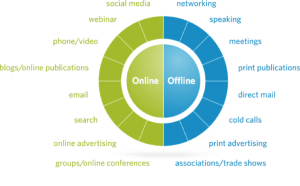
In today’s marketplace, brands must be visible both online and offline.


Online-offline


Our research on this topic bears out the reputation-visibility imbalance. About 57% of surveyed buyers rated the sellers of professional services highly for having a strong reputation, but only about 23% thought the same sellers had very good visibility.

If your goal is to enhance both visibility and reputation it is easier to focus on a single brand—the branded house strategy.

It’s no surprise that brand strength is more easily attainable under the guise of a branded house. That is because the firm channels its financial and labor resources toward strengthening a single brand, rather than diluting resources that compete in the building of multiple brands.

When a house of brands makes sense

Simply put, a strong professional services brand isn’t built overnight. Lacking the understanding of what makes an effective branding strategy, firms can easily fall prey to building a house of brands to support the diversification of services.

When that happens, the professional services firm must make accommodations for funding and staffing of multiple brands, which lead to a division of marketing budgets across all of the offerings.

Under the house of brands, the firm operates like a holding company for the various brands; managing each brand as though it were a separate company and dealing with all of the necessary legal requirements of this strategy certainly carries greater complexity.
Does that mean that a house of brands in professional services is never a good idea? Not necessarily.

In some specific cases, such as state licensure requirements, funding or liability structures make it more reasonable to pursue a house of brands approach. For example: an environmental engineering firm engaged in Superfund land reclamation services may consider a house of brands to limit liabilities.
Sometimes the matrix of brand promise and audience profile is the driver of the decision. When brands create sub brands that have unrelated brand promises (i.e. what they deliver), which in turn have a very different buyer or audience profiles, it can also make sense to create a house of brands.
The key to determining what brand strategy is most appropriate for your firm depends on strategic goals, audience, resources, and commitment. Developing a house of brands can potentially compound the challenge of building your firm’s overall brand strength. And measuring the return on investment for a single brand is not nearly as challenging as measuring that same return on many parallel brands.


Créditos de Carbono

O crédito de carbono é um conceito que surgiu em 1997, dentro do Protocolo de Kyoto. O objetivo principal dessa metodologia é reduzir a emi...